Notion works until it does not. Prices go up, features move behind AI paywalls, and everything lives on someone else’s server. The alternative that keeps growing is running a Notion-shaped workspace on your own hardware, with a Docker image that starts in a minute and a desktop client that syncs to it. We ran seven of them for a week on a homelab, focusing on what happens after the “docker compose up” high wears off.
What to look for in a self-hosted Notion alternative
Notion’s core is a block editor, nested pages, databases, and multi-user access. A self-hosted alternative should cover most of these plus a few things Notion cannot:
- A real Docker image, ideally official, with a documented
docker-compose.yml. - A native desktop client for Windows, macOS, and Linux that syncs to your server.
- A block editor with database views (table, board, calendar, gallery).
- Import from Notion or at least Markdown, so your existing content moves.
- Real-time collaboration if more than one person will use it.
- A backup story that is not “copy the volume and hope.”
Everything below meets at least four. The two full-parity picks meet all of them.
Quick comparison
| App | Best for | Platforms | Docker image | Free plan | Starting price/mo |
|---|---|---|---|---|---|
| AppFlowy | Overall Notion parity | Win/Mac/Linux | Official | Yes | $0 self-hosted |
| SiYuan | Local-first block editor | Win/Mac/Linux | Community | Yes | $0 self-hosted |
| AFFiNE | Whiteboard + docs | Win/Mac/Linux | Official | Yes | $0 self-hosted |
| Trilium Next | Personal knowledge graph | Web + desktop | Official | Yes | $0 self-hosted |
| Anytype | P2P sync (not Docker) | Win/Mac/Linux | N/A (P2P) | Yes | $0 with own node |
| Docmost | Team wiki | Web + PWA | Official | Yes | $0 self-hosted |
| Outline | Polished team wiki | Web + PWA | Official | Yes | $0 self-hosted |
The apps
1. AppFlowy, best for overall Notion parity
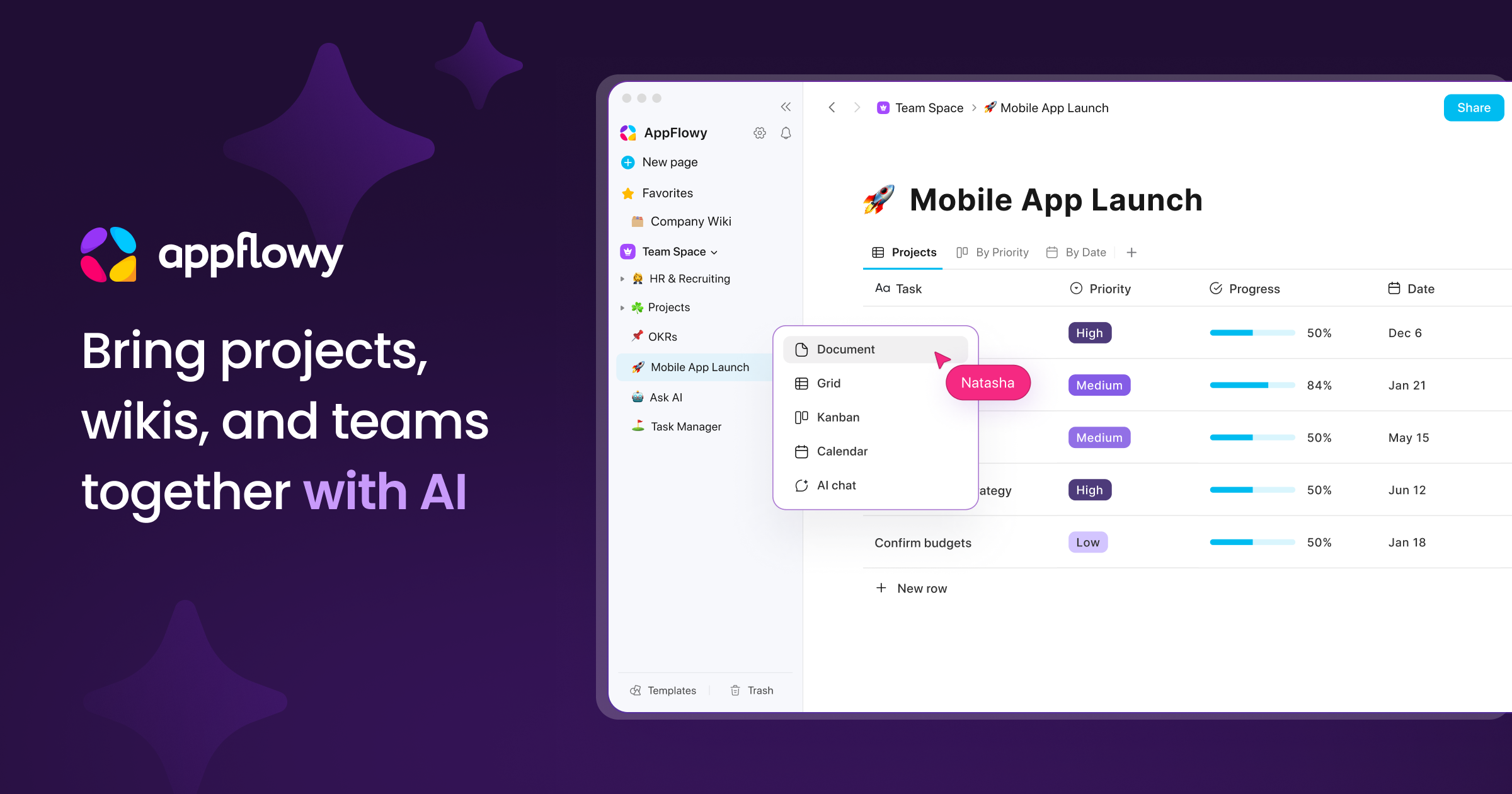
AppFlowy is the closest self-hosted Notion clone in feel. The block editor supports headings, callouts, embeds, and slash commands the way Notion users expect, and database views (grid, board, calendar) do the same job. The official Docker image ships with Postgres, Redis, and MinIO in one docker-compose.yml, and the desktop client for Windows, macOS, and Linux syncs to the self-hosted backend once you point it at your URL.
Where it falls short: The AI features that ship in AppFlowy Cloud require your own OpenAI or Ollama endpoint when self-hosted. Some database view types (timeline, gallery layouts) are still catching up. Multi-user permission settings are simpler than Notion’s.
Pricing:
- Free: full self-hosted stack, unlimited users
- Paid: AppFlowy Cloud starts around $10/user/mo if you skip self-hosting
Platforms: Windows, macOS, Linux, iOS, Android
Download: AppFlowy for desktop
Bottom line: Best pick if you want Notion muscle memory to keep working after the switch.
2. SiYuan, best for local-first block editor
SiYuan is a block-based note app built around a personal knowledge graph. Notes live on your local machine by default; a Docker image runs an optional sync/kernel server so multiple devices share the same vault. The editor supports Markdown source, block references, embeds, and math, plus a two-pane outline that pulls headings into a live sidebar.
Where it falls short: Real-time multi-user editing is not the design goal. The UI leans on Chinese-language documentation, which improves each release but still shows through in some menus. Import from Notion is Markdown-only.
Pricing:
- Free: full local install and self-hosted sync
- Paid: SiYuan cloud sync at about $6/mo per user if you skip self-hosting
Platforms: Windows, macOS, Linux, iOS, Android
Download: SiYuan for desktop
Bottom line: Best pick for one person who wants a local vault with an optional Docker sync server.
3. AFFiNE, best for whiteboard plus docs
AFFiNE combines a block editor with an infinite whiteboard, so the same page can be a document, a Kanban, and a Miro-style canvas. The official Docker image (toeverything/affine) runs Postgres and Redis alongside the app. The desktop client is Electron-based and runs on Windows, macOS, and Linux with offline mode.
Where it falls short: Sync collision handling still shows edge cases in busy multi-user rooms. The whiteboard is powerful but slower than a dedicated tool like Excalidraw in very large scenes. Import from Notion covers Markdown and pages but not databases.
Pricing:
- Free: full self-hosted stack
- Paid: AFFiNE Pro plan at $6.75/user/mo if you skip self-hosting
Platforms: Windows, macOS, Linux, iOS, Android
Download: AFFiNE for desktop
Bottom line: Best pick when your docs and diagrams live in the same head and you want them on the same page.
4. Trilium Next, best for personal knowledge graph
Trilium Next is the maintained fork of the classic Trilium Notes project. It is more of a personal wiki than a Notion clone: a tree of notes, cloneable branches, scripting inside notes, and a note-relations graph you can visualize. The Docker image is a single container with SQLite by default, with Postgres and MySQL supported. The desktop app runs on Windows, macOS, and Linux and syncs to the server.
Where it falls short: No real-time collaboration; multi-user support is via account isolation. The database-view story is thin compared to AppFlowy. Onboarding assumes you enjoy configuration.
Pricing:
- Free: fully open source, unlimited notes
- Paid: none
Platforms: Windows, macOS, Linux (native desktop), web
Download: Trilium Next for desktop
Bottom line: Best pick for one person building a knowledge vault that outgrows a flat folder of Markdown.
5. Anytype, best for P2P sync without a central server
Anytype is not Dockerized, but it earns a spot because it removes the whole “which server” question. The desktop client for Windows, macOS, and Linux is a first-class app; sync happens peer-to-peer through a network of relay nodes you can run yourself if you want. Blocks, relations, and types echo Notion’s structure with more emphasis on schema.
Where it falls short: The P2P model means initial device pairing needs both machines online. Some team features (permissions, guest access) are still catching up. There is no Docker image because the architecture is fundamentally different.
Pricing:
- Free: full features, unlimited local objects
- Paid: Anytype Membership at about $8.25/mo for extended sync limits
Platforms: Windows, macOS, Linux, iOS, Android
Download: Anytype for desktop
Bottom line: Best pick if you want a Notion-shaped tool without hosting anything at all.
6. Docmost, best for team wikis
Docmost targets teams that want a self-hosted Confluence replacement with Notion’s editor feel. The Docker image ships with Postgres and Redis, and the app runs as a PWA that installs to any desktop like a native client. Real-time multi-user editing works, permissions are per-space, and the API is documented.
Where it falls short: No native desktop app; the PWA is the closest you get. Database views are simpler than AppFlowy’s. Import from Notion is Markdown-only.
Pricing:
- Free: full self-hosted stack
- Paid: Docmost Cloud starts at $5/user/mo if you skip self-hosting
Platforms: Web, PWA on any desktop
Download: Docmost releases
Bottom line: Best pick for a team that wants a wiki-first tool with a Notion-style editor.
7. Outline, best for polished team wikis
Outline is closer to a Notion competitor built for engineering teams. The official Docker image runs the server and connects to Postgres, Redis, and an S3-compatible bucket. The editor is fast, Markdown-native, and supports live cursors. The PWA is polished; the native desktop client is Electron-based on Windows, macOS, and Linux.
Where it falls short: No database views. The free self-hosted version requires configuring an SSO provider (Google, Slack, or OIDC), which is more setup than a fresh account signup. Pricing on the hosted version has climbed in the last two years.
Pricing:
- Free: full self-hosted stack, unlimited users
- Paid: Outline Cloud starts at $10/user/mo if you skip self-hosting
Platforms: Windows, macOS, Linux, web, PWA
Download: Outline for desktop
Bottom line: Best pick for a team that treats its wiki as a product and is willing to configure SSO.
How to pick the right one
- If you want the closest Notion clone: AppFlowy. The editor, database views, and slash commands all map cleanly.
- If you are the only user: SiYuan or Trilium Next. Both are local-first and skip the server-side overhead for solo workflows.
- If your docs and canvases live together: AFFiNE.
- If you refuse to run any server at all: Anytype. P2P sync removes the hosting question entirely.
- If your team wants a real wiki: Docmost for smaller teams, Outline for larger ones.
- If you already tried self-hosted Notion clones once and gave up: AppFlowy’s Docker install is the least fiddly of the seven and the one most likely to still be running six months later.
FAQ
What is the best free self-hosted Notion alternative?
AppFlowy for a Notion-like experience, SiYuan or Trilium Next for personal knowledge management. All three are fully free at self-hosted scale with active maintenance.
Can I import my Notion pages into these apps?
AppFlowy and AFFiNE both have Notion importers that handle pages and nested content; databases move as tables. Docmost and Outline support Markdown import, which covers Notion’s Markdown export cleanly. Trilium Next and SiYuan import Markdown too.
Do any of these run entirely offline?
SiYuan, Trilium Next, Anytype, and the desktop builds of AppFlowy and AFFiNE all work offline. Docmost and Outline are web-first and need the server running, though a PWA offline mode covers short outages.
Which self-hosted Notion alternative has real-time collaboration?
AppFlowy, AFFiNE, Docmost, and Outline all support live multi-user editing with cursors. Trilium Next and SiYuan focus on single-user workflows with sync between your own devices.
Do I need a public IP address to self-host these?
Only if you want to reach the server from outside your network. All seven work fine on a LAN or through a WireGuard tunnel to a home server, and the desktop clients sync over whatever URL you configure.