Orbitals launched on Nintendo Switch 2 on September 3, 2026, and it isn’t coming to PC. Shapefarm’s co-op puzzle platformer earned the kind of reviews that make that fact sting: Polygon called it the best co-op game since It Takes Two, and Eurogamer put it in the same conversation as Astro Bot for platforming craft. If you don’t own a Switch 2, or you’d rather play with a friend over Steam Remote Play than on a shared couch, Orbitals alternatives are the next best move.
We picked seven PC co-op games that cover the same ground Orbitals reviewers praised: tight two-player puzzle design, a partner mechanic that actually asks you to communicate, and platforming that rewards precision over button mashing. Some are the exact games critics used as the comparison point. Others come at the same itch from a different angle. All seven run on Windows, macOS, or Linux and support local or online co-op.
Quick comparison
| App | Best for | Players | Friend’s Pass | Price |
|---|---|---|---|---|
| It Takes Two | Closest peer to Orbitals | 2 | Yes | $39.99 |
| Split Fiction | Latest Hazelight co-op | 2 | Yes | $49.99 |
| Portal 2 | Asymmetric two-brain puzzles | 1-2 | No | $9.99 |
| A Way Out | Where the Hazelight formula started | 2 | Yes | $29.99 |
| Unravel Two | Softer visual co-op platformer | 1-2 | No | $19.99 |
| Overcooked 2 | Frenetic party co-op | 1-4 | No | $24.99 |
| Lovers in a Dangerous Spacetime | Asymmetric two-person ship crew | 1-2 | No | $14.99 |
What makes Orbitals worth chasing
Shapefarm built Orbitals around an asymmetrical two-player structure: Maki and Omura don’t play the same game side by side, they play two halves of one puzzle that only resolve when both players commit to their own role and trust the other to handle theirs. Neither character can brute-force a level alone, and neither one is the “support” character while the other does the real platforming. Reviewers singled out how evenly the design splits the challenge between both seats.
The anime-inspired art direction gives every level a distinct palette and silhouette, closer to a hand-animated short than a typical indie platformer. And Kepler Interactive’s publishing fingerprints show in the polish: consistent frame pacing, no rough edges in the co-op camera, load times that don’t break the rhythm of a puzzle handoff. It’s the combination Polygon pointed at when it reached for It Takes Two as the comparison. That game remains the standard for asymmetric co-op design on PC, which is exactly why it tops this list.
The 7 PC co-op games that come closest
It Takes Two
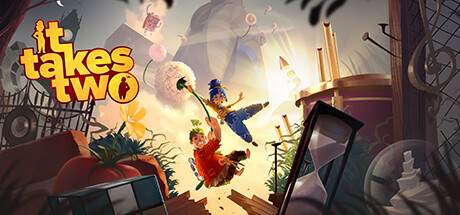
Josef Fares and Hazelight’s It Takes Two puts a bickering couple inside the bodies of two dolls, then builds an entire game around a new mechanic every fifteen minutes. Each chapter hands the two players genuinely different tools, so no one is stuck holding a flashlight while the other one plays. It’s the game every review of Orbitals reached for first.
Where it falls short: The story leans hard into a marriage-counseling metaphor that some players find heavy-handed. A few late-game sections stretch a mechanic past its welcome.
Pricing:
- Base price: $39.99
- Friend’s Pass: the second player joins free with just one copy owned
Why it fits the Orbitals gap: Same asymmetric split, same constant mechanical reinvention, same emphasis on genuine two-player problem solving rather than one player carrying. It’s the PC game Orbitals gets compared to most.
Download: Steam
Bottom line: If you can only buy one game from this list, buy this one.
Split Fiction
Hazelight’s 2025 follow-up to It Takes Two sends two writers into their own competing story worlds, sci-fi and fantasy, that keep colliding into each other. It keeps the studio’s signature move of a new mechanic every chapter, but raises the production values and the sheer number of set pieces.
Where it falls short: The dual-genre structure means neither the sci-fi nor fantasy half gets as much room to breathe as a full game would give it. Some chapters favor one player’s screen more than the other’s.
Pricing:
- Base price: $49.99
- Friend’s Pass: the second player joins free with just one copy owned
Why it fits the Orbitals gap: It’s the most recent example of the same studio doing what made It Takes Two work, with an even larger scope and more inventive puzzle-platforming per hour.
Download: Steam
Bottom line: Pick this if you’ve already finished It Takes Two and want the same team’s newest, bigger idea.
Portal 2
Valve’s Portal 2 co-op campaign puts two robots, Atlas and P-body, through test chambers designed exclusively around two portal guns working together. Neither robot can solve a chamber alone; the puzzles are built from the ground up around two independent viewpoints coordinating in real time.
Where it falls short: The co-op campaign is a separate, shorter mode from the acclaimed single-player story, so newcomers sometimes miss the narrative hook. Visual style is minimalist compared to Orbitals’ art direction.
Pricing:
- Base price: $9.99, frequently discounted further
Why it fits the Orbitals gap: This is the purest “two brains, one puzzle” design on PC. Neither player can lean on the other; every chamber demands both portal guns working in sync, the same demand Orbitals makes of Maki and Omura.
Download: Steam
Bottom line: The cheapest, purest asymmetric puzzle co-op on this list, and still one of the best.
A Way Out
Before It Takes Two, Hazelight made A Way Out, a split-screen-only prison break where two convicts have to work together to escape and then survive on the outside. The split-screen camera is permanent, forcing both players to watch each other’s half of the story unfold in real time.
Where it falls short: Combat and stealth sections are simpler than Hazelight’s later games. The story’s tone shifts are less polished than It Takes Two’s.
Pricing:
- Base price: $29.99
- Friend’s Pass: the second player joins free with just one copy owned
Why it fits the Orbitals gap: This is where Hazelight’s asymmetric-roles formula started, and it still holds up as a tighter, more grounded two-player experience than its sequels.
Download: Steam
Bottom line: Pick this for the formula’s origin point at a lower price than its sequels.
Unravel Two
Coldwood Interactive’s Unravel Two hands two players a single strand of yarn each, and the physics-based platforming only works when both threads move in coordination. The visual style is soft and painterly, a gentler contrast to the anime sharpness of Orbitals but built on the same idea of two small figures solving a level together.
Where it falls short: Shorter than most games on this list, and single-player mode requires controlling both yarn characters at once, which loses the co-op appeal entirely.
Pricing:
- Base price: $19.99, frequently discounted
Why it fits the Orbitals gap: Its physics-linked co-op forces the same constant communication Orbitals reviewers praised, just wrapped in a softer, more melancholic visual package.
Download: Steam
Bottom line: Pick this for a shorter, gentler two-player platformer with real mechanical co-dependence.
Overcooked 2
Ghost Town Games’ Overcooked 2 turns kitchen chaos into a co-op puzzle: up to four players chop, cook, plate, and wash dishes against a timer, and every level is really a logistics puzzle about who does what and when. It trades Orbitals’ quiet precision for controlled panic, but the underlying design, splitting one job across multiple players who each own a piece, rhymes closely.
Where it falls short: No real story or platforming; it’s purely a puzzle-under-pressure kitchen sim. Later levels get gimmicky with moving stages and conveyor belts.
Pricing:
- Base price: $24.99, frequently discounted
Why it fits the Orbitals gap: It’s the loudest, most party-friendly pick here, for groups who want the “everyone has a role that matters” structure without the puzzle-platformer pacing.
Download: Steam
Bottom line: Pick this when you want co-op chaos for a group rather than a quiet two-player puzzle session.
Lovers in a Dangerous Spacetime
Asteroid Base’s Lovers in a Dangerous Spacetime puts two players inside a single spherical spaceship, running between stations to man guns, shields, and engines while asteroids and enemy fleets close in. Like Orbitals, no one player can win alone; the ship only survives when both players are constantly repositioning to cover for each other.
Where it falls short: Single-player mode is noticeably weaker since one person has to sprint between every station alone. Repetitive after a few runs without co-op partners rotating in.
Pricing:
- Base price: $14.99, frequently discounted
Why it fits the Orbitals gap: It’s the clearest asymmetric-roles-on-one-shared-object design here outside of Orbitals itself. Two players, one vehicle, constant negotiation over who covers what.
Download: Steam
Bottom line: Pick this for a fast, colorful two-player co-op session that leans into constant role-switching.
How to pick the right one
Start with It Takes Two if you haven’t played it. It’s the game Polygon and Eurogamer both reached for when describing Orbitals, and the Friend’s Pass means only one of you needs to buy it. If you’ve already finished that, Split Fiction is the same studio’s newer, bigger take on the formula, also with a Friend’s Pass.
Want the purest puzzle-first experience, closer to Orbitals’ emphasis on two-brain problem solving over story? Portal 2 is the cheapest entry point and still one of the sharpest co-op puzzle designs ever shipped. A Way Out is worth a look if you’d rather see where Hazelight’s approach began, at a lower price than its sequels.
For something visually softer than Orbitals’ anime style, Unravel Two trades sharp character design for a painterly, physics-driven platformer. If your group is bigger than two or you want energy over precision, Overcooked 2 turns the same “everyone owns a role” idea into party chaos. And if you want the asymmetric-roles idea distilled into constant motion around a shared object, Lovers in a Dangerous Spacetime delivers that in short, replayable runs.
Budget matters too. Portal 2 and Lovers in a Dangerous Spacetime sit under $15, while It Takes Two and Split Fiction ask more but only require one copy per pair thanks to their Friend’s Pass programs.
FAQ
Is Orbitals coming to PC?
There’s no indication of that as of this writing. Shapefarm and Kepler Interactive have positioned Orbitals as a Switch 2 exclusive, and neither party has announced plans for a Windows, PlayStation, or Xbox release.
Is It Takes Two free with Friend’s Pass?
Yes. One player buys the full game, and that purchase unlocks a Friend’s Pass that lets a second player download and play the full co-op campaign at no cost, as long as the host is online or in the same room.
What’s the best two-player co-op game on Steam?
It Takes Two is the most commonly cited answer, and it’s also the closest match to what reviewers praised in Orbitals. Portal 2 and Split Fiction are the next strongest picks depending on whether you want puzzle-first design or a newer, bigger production.
Is Split Fiction related to It Takes Two?
Yes. Both come from Hazelight Studios and director Josef Fares, and both use the same core idea of splitting a level’s mechanics between two players who each play a genuinely different role. Split Fiction is the newer, larger-scope game.
Is Portal 2 co-op split-screen on PC?
No. Portal 2’s co-op campaign runs online or over a local network with each player getting their own full screen, not a shared split-screen view. Local play on one machine with two controllers isn’t supported the way it is in games like A Way Out.