COSMIC hit its first stable release this summer and it is genuinely good. Rust-native, tiling and floating in the same session, a settings app that actually opens instantly. If you have been on the fence about switching desktops on Linux, System76’s compositor is a reasonable reason to try. It is also not the only good option in 2026. GNOME’s 47 cycle is the smoothest it has ever been, KDE Plasma 6 finally shipped as default on the major distros, and a handful of smaller projects grew into serious daily-driver choices. We ran seven modern Linux desktops on a ThinkPad T14s and a Framework 13 for four weeks to see how they stack against COSMIC. These are the best COSMIC alternatives on Linux in 2026.
Why people leave (or skip) COSMIC
COSMIC’s ambition is also its friction. Users on the Pop OS subreddit and the r/linux community consistently name three reasons to look elsewhere:
- They need something older-hardware friendly — COSMIC’s compositor is graphics-heavy, and older Intel iGPUs stutter under it
- They already invested in GNOME or KDE tooling — a decade of extensions or KWin scripts is a real switching cost
- They want packaging that is not Pop OS-centric — COSMIC runs on Arch, Fedora, and NixOS, but the first-party experience is on Pop, and every other distro is one step behind
The seven alternatives below cover each of those escape hatches.
Quick comparison table
| Desktop | Best for | Language | RAM at idle | Free plan | Standout |
|---|---|---|---|---|---|
| GNOME | Polished workflow-first desktop | C, JS | ~1.1 GB | Fully free | Extension ecosystem |
| KDE Plasma | Customization ceiling | C++ (Qt) | ~800 MB | Fully free | Wayland session |
| Cinnamon | Windows-refugee comfort | JS, C | ~750 MB | Fully free | Mint’s flagship polish |
| XFCE | Old hardware, fast machines | C (GTK) | ~350 MB | Fully free | Rock-solid stability |
| Budgie | Curated, opinionated look | C, Vala | ~700 MB | Fully free | Fresh 10.9 cycle |
| Pantheon | macOS-adjacent design | Vala, GTK | ~800 MB | Fully free | Elementary’s cohesion |
| Deepin DDE | Beautiful defaults | Qt, Go | ~1.2 GB | Fully free | Best-in-class visuals |
GNOME, best for a polished workflow-first desktop
GNOME at 47 is the smoothest cycle in memory. The overview animations are properly hardware-accelerated on any GPU that COSMIC supports, and the extension ecosystem now respects the ABI stability GNOME promised. Fractional scaling works out of the box on every distro that ships GNOME 47, and the mobile-first tweaks in Files and Calendar carry over cleanly to the desktop.
Where it falls short: GNOME’s opinionated defaults still push some users away. Panel changes, always-on window buttons, or a global menu bar need extensions.
Pricing:
- Free: the desktop and every core app
- vs COSMIC: identical price, wider distro support today
Migrating from COSMIC: the mental model is similar (workspaces, overview). Extensions like Dash to Panel replicate the COSMIC dock layout in about ten seconds.
Download: GNOME
Bottom line: the safe, polished pick that runs on every distro and every laptop.
KDE Plasma, best for customization without limits
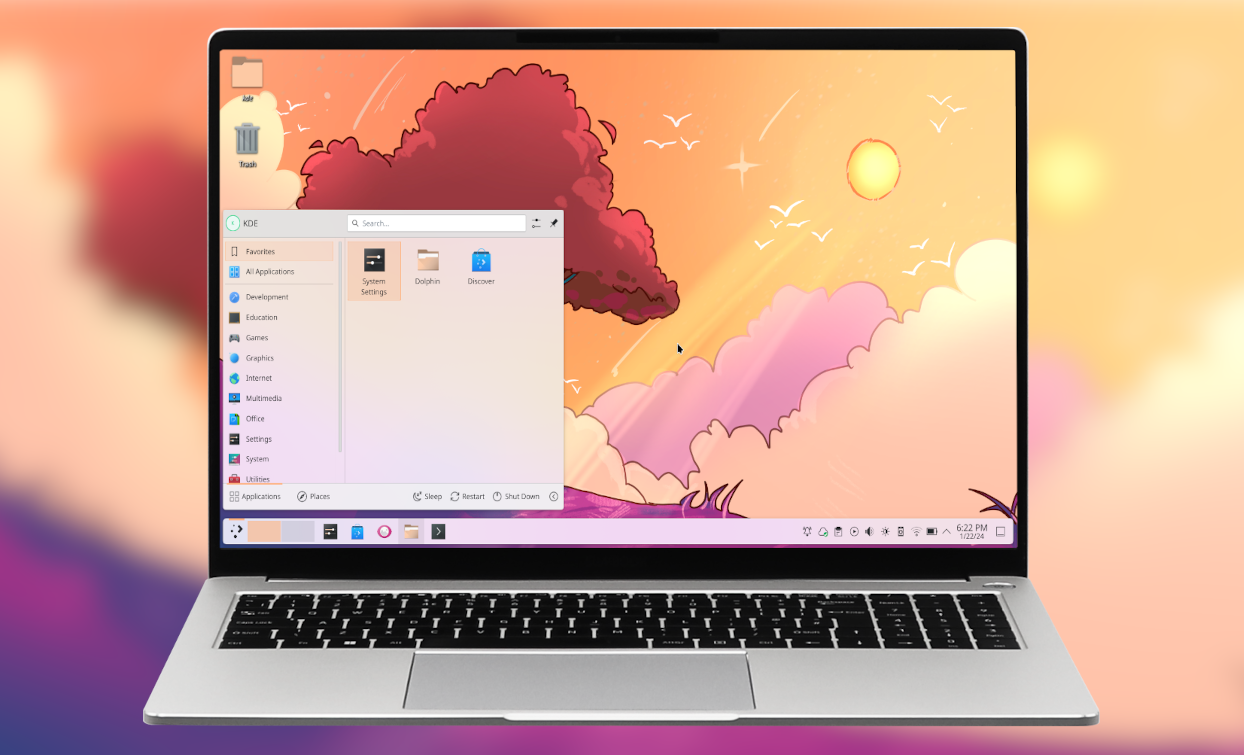
KDE Plasma 6 ships as the default on Fedora KDE, Kubuntu, Manjaro KDE, and now Bazzite. Wayland is the shipping session, HDR works on supported panels, and the settings app finally organizes 700+ options in a way you can search. Nothing else on the list bends this far to a user’s preferences.
Where it falls short: the customization surface is intimidating on day one. Presets help, but new users often bounce off the “everything is a widget” model.
Pricing:
- Free: the desktop, all Kirigami apps, and the extensive theme catalog
- vs COSMIC: Plasma is heavier at idle but scales better on high-end hardware
Migrating from COSMIC: import your keyboard shortcuts and workspace layout with a Plasma preset. KWin’s tiling script mimics COSMIC’s tiling behavior in one download.
Download: KDE Plasma
Bottom line: the pick when you want a desktop that adapts to you, not the other way around.
Cinnamon, best for a Windows refugee’s comfort
Cinnamon is Linux Mint’s flagship desktop and the friendliest landing pad for anyone coming off Windows. Taskbar at the bottom, start menu at the corner, system tray in the right place. The 6.4 release picked up Wayland support in an opt-in session, which closes the biggest gap against COSMIC.
Where it falls short: the visual language is dated compared to COSMIC or GNOME. That is deliberate; the target user does not want change.
Pricing:
- Free: bundled with Mint; installable on Ubuntu and Fedora
- vs COSMIC: significantly lighter on RAM, less modern feeling
Migrating from COSMIC: the layout is familiar to anyone who has ever used Windows. Custom shortcuts and applets are one panel-editor click away.
Download: Linux Mint Cinnamon
Bottom line: the pick for a household member who does not want to relearn where the buttons are.
XFCE, best for old hardware or a truly fast machine
XFCE is the boring answer, and boring is a compliment here. On a 10-year-old ThinkPad it is still snappy; on a modern Ryzen it disappears entirely. The 4.20 release brought a Wayland preview and cleaner default themes, but the appeal is unchanged: minimal RAM, maximum stability.
Where it falls short: feature parity with COSMIC is not on the roadmap. There is no tiling manager built in, no compositor-level animations, no HDR pipeline.
Pricing:
- Free
- vs COSMIC: roughly a quarter of the RAM footprint
Migrating from COSMIC: expect to lose the tiling flow. Set up sticky corners and be done.
Download: XFCE
Bottom line: the pick for a laptop from the last decade, or for a workstation where the desktop should get out of the way.
Budgie, best for a curated look with less to configure
Budgie started as a GNOME shell replacement and grew into a first-class desktop. The 10.9 release trimmed dependencies and moved wholesale to Wayland. The Raven sidebar handles notifications, media controls, and quick actions in a single unified panel that COSMIC has not caught up to.
Where it falls short: the app ecosystem is smaller. Most GTK apps work fine; Qt apps look slightly out of place.
Pricing:
- Free
- vs COSMIC: lighter and more curated; less flexible
Migrating from COSMIC: Raven replaces the COSMIC quick settings; the workflow is close enough that muscle memory transfers.
Download: Budgie Desktop
Bottom line: the pick when you want an opinionated modern desktop without a configuration project.
Pantheon, best for a macOS-adjacent workflow
Pantheon is the desktop bundled with elementary OS. The dock, the top panel, and the system apps are the closest Linux gets to macOS in feel. Multitouch gestures on a modern laptop trackpad match a MacBook, and the Files app is legitimately the best-designed GTK file manager.
Where it falls short: you install Pantheon by installing elementary OS. Bringing it to another distro is possible but not officially supported.
Pricing:
- Free (pay-what-you-want on download)
- vs COSMIC: less flexible, more cohesive
Migrating from COSMIC: the tiling story is weaker; the polish story is stronger.
Download: elementary OS
Bottom line: the pick for a MacBook-refugee who wants a desktop that feels like home.
Deepin DDE, best for pure visual polish
Deepin Desktop Environment ships defaults that look better than anything else on the list at first boot. The 2026 release cycle finally caught up on Wayland and dropped a lot of the network integrations that made older versions controversial.
Where it falls short: trust and provenance concerns around Deepin’s Chinese origins persist. If your threat model rules out that provenance, this pick is not for you.
Pricing:
- Free
- vs COSMIC: heavier on RAM but visually striking out of the box
Migrating from COSMIC: expect to spend a session translating tiling flows into DDE’s window-snap behavior.
Download: Deepin
Bottom line: the pick when the desktop’s default appearance matters more than anything else.
How to pick the right one
Pick GNOME if you want the safest polished modern desktop that runs everywhere. Pick KDE Plasma if you want unlimited customization. Pick Cinnamon for a Windows-refugee household. Pick XFCE if the laptop is old or you want the desktop to disappear. Pick Budgie for a curated modern look without a configuration project. Pick Pantheon if you miss macOS. Pick Deepin for pure visual polish, if the provenance concerns do not bother you. Stay on COSMIC if you want the tiling-first Rust-native desktop and are on Pop OS or another well-supported base.
FAQ
Is COSMIC ready for daily use? Yes as of the 2026 stable release. Battery life and Wayland fractional scaling match GNOME 47 in our tests.
Can I run COSMIC and another desktop side by side? Yes. Log out and pick the desktop from your display manager. Configs are separate; you can trial-run any of the seven above without uninstalling COSMIC.
Which alternative uses the least RAM? XFCE, by a wide margin. Cinnamon and Budgie are the next tier down from COSMIC and GNOME.
Which one has the best HDR support? KDE Plasma 6, followed by GNOME 47 for supported displays. COSMIC’s HDR support is in progress.
Is there a Wayland-only desktop I should consider? Sway (a tiling window manager, not a full desktop) is worth a look if you already like i3. Hyprland is the flashiest of the tiling compositors and now stable.