Hyprland looks incredible in a screen recording, and then you spend Sunday afternoon in hyprland.conf because a rolling release nudged a keyword and your bind lines stopped parsing. The animations are real, the blur is real, and so is the maintenance tax on a compositor that ships breaking changes between minor versions, leans on wlroots-fork behaviour that some GPU drivers still argue with, and asks you to hand-configure screensharing portals every time xdg-desktop-portal-hyprland moves. NVIDIA users know the drill: kernel modules, WLR_NO_HARDWARE_CURSORS, a chase through GitHub issues.
We tested seven Hyprland alternatives on Arch, Fedora 42, and NixOS. The list keeps the “tiling on Wayland with modern effects” premise and adds the parts Hyprland asks you to supply yourself: sensible defaults, a config GUI where useful, and an upgrade path that does not require reading the changelog every fortnight.
Quick comparison
| Compositor / DE | Best for | Config surface | Effects | Tiling model |
|---|---|---|---|---|
| KDE Plasma (KWin) | Ex-Hyprland users who want a GUI for everything | Systemsettings + text | Blur, wobbly, shaders, animations | Manual tiling manager, Krohnkite for auto |
| GNOME | Multi-monitor users who value stability over knobs | Extensions + dconf | Modest, GPU-cheap | PaperWM (scroll), Forge, Pop Shell |
| Sway | i3 refugees who want the same file to just work | Text (i3 subset) | None by default | Manual, i3 tree |
| Niri | Fans of the PaperWM scrollable model on a modern base | KDL text file | Subtle motion | Scrollable columns |
| River | Minimalists who like a shell-script init | Shell script + riverctl | None by default | Dynamic layout generators |
| COSMIC | Users who want tiling built in and a proper installer | Settings app + config files | Modern, restrained | Auto-tile toggle per workspace |
| Wayfire | Effects enthusiasts who want a GUI to reach them | wcm GUI + text | 3D cube, expo, blur, wobbly | Plugins for tiling |
Why people leave Hyprland
The complaints are boring in a good way. Nothing on this list is “Hyprland is bad”; each item is a friction people hit after a few months.
- Config churn between releases. Hyprland’s
hyprland.confgrammar has changed keywords and defaults across minor versions more than once. A working file can start emitting parse errors afterpacman -Syuwithout touching a byte. - NVIDIA is still a project. The wiki has a dedicated NVIDIA page for a reason. Hardware cursors, explicit sync, and the proprietary driver combine to produce flicker, black frames, or Xwayland tearing until each workaround is set.
- Screensharing and portals.
xdg-desktop-portal-hyprlandworks, and it also breaks in waysxdg-desktop-portal-wlror-kdedo not, because it is younger and tracks Hyprland’s own protocol quirks. - Dotfile debugging is the hobby. Waybar, hyprpaper, hypridle, hyprlock, hyprpicker, hyprcursor: seven daemons wired together in text, each with its own release cadence and its own broken-config day.
- Community drama around the fork. The wlroots relationship, the aquamarine backend, the various forks of forks: keeping up is a second job, and it leaks into which distro packages actually track upstream.
The seven alternatives
KDE Plasma — Best overall replacement
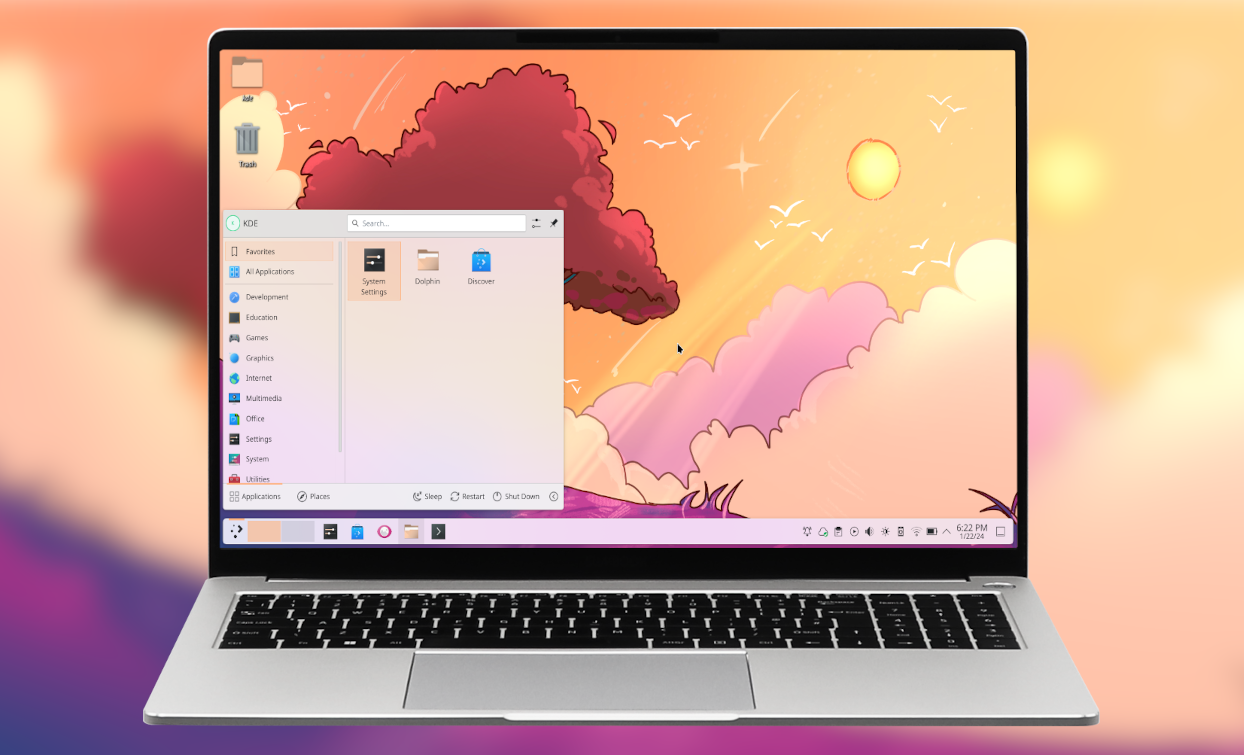
KDE Plasma is the answer for the ex-Hyprland user who wants blur, animations, and per-monitor scaling without editing a text file. Plasma 6 is Wayland-first, KWin ships a tiling manager (Meta+T to edit the layout, then windows snap into it), and the effects engine covers wobbly windows, magic lamp, shaders, and blur behind panels. Configuration lives in Systemsettings, so a change is a checkbox rather than a keyword hunt.
Where it falls short: KWin’s tiling is manual by default. If you want automatic i3-style behaviour, install Krohnkite or Polonium, both of which are KWin scripts rather than first-party features. The stack is larger than a bare compositor, and it shows in RAM on modest hardware.
Pricing:
- Free: Everything, GPL
- Paid: None. Donations to KDE e.V.
- vs Hyprland: More features out of the box, less time in a text editor
Migrating from Hyprland: Wallpapers and per-monitor scaling move over cleanly through Systemsettings. Keybinds are set under Shortcuts and can be exported as a .kksrc. For a tiling workflow closer to Hyprland, install Krohnkite from the KDE store, pick the layout, and set Meta as the mod key.
Download: kde.org/plasma-desktop · KDE distros list
Bottom line: The right pick for anyone who liked the look of Hyprland but is done fighting text config. Skip it if a full DE feels like too much and a bare compositor is the goal.
GNOME — Best stable base with tiling extensions
GNOME is the opposite philosophy from Hyprland and, for many ex-Hyprland users, the reason it works. Wayland is default, HDR landed in the 47 line, fractional scaling has been solid for two releases, and Mutter handles multi-monitor with less fuss than most wlroots setups. The extension ecosystem covers the tiling case: PaperWM for a scrollable, Niri-like workspace; Pop Shell for i3-style auto-tile; Forge for a more aggressive Awesome-flavoured layout.
Where it falls short: Extensions are third-party and can break on GNOME major version bumps. GNOME is opinionated about what belongs in Settings, so certain tweaks (window button placement, focus-follows-mouse) still require dconf or Tweaks.
Pricing:
- Free: Everything, GPL
- Paid: None
- vs Hyprland: Far fewer knobs, and that is the point
Migrating from Hyprland: Install GNOME, add PaperWM if the Hyprland habit was column-style scrolling, or Pop Shell if it was master-stack tiling. Waybar’s role is played by the top bar plus extensions like Vitals. Keybinds are set under Settings, Keyboard, View and customize shortcuts.
Download: gnome.org · Fedora Workstation
Bottom line: The right pick for someone who wants Wayland to be a solved problem and is willing to accept GNOME’s defaults. Skip it if extension breakage on upgrade day is a dealbreaker.
Sway — Best i3-on-Wayland
Sway is what happens when the i3 config format meets wlroots and stops there. There are no animations, no blur, no shaders; there is a rock-solid tiling window manager that reads a familiar text file and runs for years without drama. The 1.10 line brought explicit sync and better NVIDIA support, and swaymsg, swaybar, swayidle, and swaylock cover the daemons Hyprland asks you to assemble from parts.
Where it falls short: No effects. If the reason Hyprland grabbed you was the animation on window open, Sway will feel flat. It is also not a full desktop; you bring your own notification daemon, launcher, and app menu.
Pricing:
- Free: Everything, MIT
- Paid: None
- vs Hyprland: Same paradigm, tenth of the churn, none of the polish
Migrating from Hyprland: The transition is smaller than most: many Hyprland keybinds map to i3-compatible syntax with light editing. Reuse Waybar (it works on Sway), swap hyprpaper for swaybg, swap hypridle for swayidle, and keep wl-clipboard, grim, and slurp as-is.
Download: swaywm.org · GitHub
Bottom line: The right pick for anyone whose Hyprland config was mostly keybinds and rules. Skip it if the effects were the reason.
Niri — Best scrollable tiling on Wayland
Niri is a scrollable-tiling Wayland compositor written in Rust on Smithay, so it sits outside the wlroots family entirely. Workspaces are horizontal rows and windows are columns; you scroll rather than switch, and there is no maximised state to fight. Configuration is a single KDL file with a schema documented alongside it, and the release notes are usually one screen long rather than fifteen.
Where it falls short: The scrollable model is a real shift. If muscle memory expects master-stack or dwm-style layouts, expect a week of retraining. Effects are subtle; the point is motion clarity, not spectacle.
Pricing:
- Free: Everything, GPL-3.0
- Paid: None
- vs Hyprland: Different tiling philosophy, smaller surface area, calmer release cadence
Migrating from Hyprland: Copy the KDL sample config from the repo, port keybinds one section at a time, and reuse Waybar or install the officially recommended niri panel. xdg-desktop-portal-gnome is the recommended portal, which sidesteps the Hyprland portal fork question.
Download: github.com/YaLTeR/niri · Niri wiki
Bottom line: The right pick for anyone who loved PaperWM but wanted a compositor built for it. Skip it if scrolling instead of switching sounds like a downgrade.
River — Best minimalist dynamic tiler
River is a dynamic-tiling wlroots compositor with a design decision that puts off some people and delights others: layouts live in external processes called layout generators, and the compositor talks to them over Wayland. The init file is a shell script that calls riverctl to set keybinds, rules, and layout, which means the “config” is code you can read top to bottom.
Where it falls short: No animations, no blur, no built-in status bar. The learning curve is real if a shell-script-as-config is not familiar, and the community is smaller than Sway’s or Niri’s.
Pricing:
- Free: Everything, GPL-3.0
- Paid: None
- vs Hyprland: Vastly smaller codebase, vastly less to break
Migrating from Hyprland: Copy the sample init from the wiki, replace hyprctl calls with riverctl equivalents, and reuse Waybar, wl-clipboard, and grim. Rivertile is the default layout generator; swap in wideriver or another if the master-stack does not fit.
Download: codeberg.org/river/river · River wiki
Bottom line: The right pick for the reader who owns their init file and wants nothing between them and the compositor. Skip it if a bare toolbox is not the appeal.
COSMIC — Best modern DE with tiling built in
COSMIC is System76’s Rust rewrite of the Pop!_OS shell as a first-class desktop environment. Tiling is a per-workspace toggle (Super+Y) rather than a plugin, cosmic-comp handles Wayland, and Settings ships with proper keybind, gesture, and display controls. The public beta cadence through 2026 has been steady, and the epic-level tickets closed in the run-up to 1.0 covered HDR, accessibility, and multi-user session robustness.
Where it falls short: Some third-party GTK apps still show minor theming rough edges under cosmic-comp, and the app catalogue (Files, Store, Player) is still catching up to KDE’s or GNOME’s in feature depth.
Pricing:
- Free: Everything, GPL-3.0
- Paid: None
- vs Hyprland: Tiling as a toggle, not a philosophy
Migrating from Hyprland: Install a Pop!_OS 24.04 or Fedora COSMIC spin, enable Auto-tile on the workspaces where the habit lives, and set the mod key in Settings. Keybinds import from a text file. NVIDIA has been a first-tier target for System76, so the driver dance is shorter than most wlroots stacks.
Download: system76.com/cosmic · GitHub
Bottom line: The right pick for someone who wants Hyprland’s tiling instincts inside a real, supported desktop environment. Skip it if a 1.0 label is a hard prerequisite.
Wayfire — Best if the effects were the reason
Wayfire is the compositor Hyprland’s animation flair borrows from, with a plugin architecture that predates the current Wayland effect scene by years. The 3D cube, expo, wobbly windows, blur, and dim-inactive are all first-party plugins, and the Wayfire Config Manager (wcm) is a proper GUI: click a plugin, tick options, save. Tiling is available through the simple-tile and hycov plugins.
Where it falls short: Not tiling-first out of the box; you enable it. Community is smaller than Sway’s, and some plugins lag Wayland-protocol updates by a release. Wayfire is closer to a hobbyist compositor than a distro default.
Pricing:
- Free: Everything, MIT
- Paid: None
- vs Hyprland: Similar effect surface, GUI configuration, less breakage between releases
Migrating from Hyprland: Install Wayfire and wcm from your distro, enable simple-tile, and set keybinds from the GUI rather than a text file. Waybar, wl-clipboard, grim, and slurp all work unchanged. Animations that took animations { blocks in Hyprland are checkboxes here.
Download: wayfire.org · GitHub
Bottom line: The right pick for anyone who wanted the 3D cube more than the tiling. Skip it if a large plugin surface sounds like a maintenance risk of its own.
How to choose
Pick KDE Plasma if the reason to leave Hyprland is “the config”, not “the aesthetic”. You get the effects, per-monitor scaling, and Wayland maturity, and you configure them in a settings app rather than a keyword grammar that changes.
Pick GNOME if a stable multi-monitor experience matters more than tiling ideology. Add PaperWM or Pop Shell to get the movement patterns back without owning the compositor.
Pick Sway if the Hyprland setup was mostly keybinds, rules, and one Waybar. Sway is what a stable Hyprland would look like without the effects, and the config file port is a weekend, not a month.
Pick Niri if the movement was the feature. Scrollable columns replace the maximise-and-shuffle dance, and the KDL config plus Smithay base is much smaller to reason about than a wlroots fork.
Pick River if owning the shell script is the point. It is the closest thing in the modern Wayland space to a dwm mindset, and it does not pretend otherwise.
Pick COSMIC if you want a supported desktop with tiling on tap. It is the only option on this list that treats “auto-tile a workspace” as a first-class Settings toggle inside a full DE.
Pick Wayfire if the 3D cube is the thing you actually miss. A GUI for the effects, a plugin for tiling, and a smaller upgrade risk than a fast-moving compositor.
Stay on Hyprland if the churn is a feature, not a bug. The animations remain best in class, and the community is still where the new Wayland ideas land first.
FAQ
Is KDE Plasma really a Hyprland alternative?
For a user whose complaint is configuration overhead, yes. Plasma 6’s KWin ships a built-in tiling manager, Meta-driven keybinds, and per-monitor scaling that Hyprland asks you to assemble from text. It is not a bare compositor, and it will feel heavy if that was the appeal.
Which of these has the least NVIDIA pain?
GNOME and KDE Plasma, because Mutter and KWin both treat the proprietary driver as a first-tier target. Sway and Niri are workable on modern drivers with explicit sync but expect to read a wiki. Wayfire and River are the lightest tested on NVIDIA.
Can I keep Waybar, wl-clipboard, and grim?
Yes on Sway, Niri, River, Wayfire, and COSMIC (with minor tweaks). Waybar’s Hyprland module obviously stops applying, but the compositor-agnostic modules keep working. On KDE and GNOME, use the native panel instead; Waybar makes less sense inside a full DE.
What is the closest one-to-one Hyprland swap?
Wayfire for the effects, Sway for the tiling and stability, Niri if scrolling is your movement style. There is no single compositor that reproduces Hyprland’s exact defaults; each of the three trades a different piece.
Do any of these support HDR yet?
GNOME (Mutter) and KDE Plasma (KWin) both have working HDR paths on supported hardware in 2026. COSMIC targets HDR for 1.0. Sway, Niri, River, and Wayfire are behind on this specifically.
Is COSMIC stable enough for daily driving?
The beta line through mid-2026 is what most reviewers are running as their primary desktop. It is not 1.0, and third-party GTK app theming has rough edges, but the core session, tiling, and display handling are day-to-day usable.